Bookkeeping for real estate investors and landlords
Rental and investment property books break in predictable places: every property's income and costs mixed together, security deposits recorded as income, repairs and improvements lumped into one bucket, and a lender asking for statements you don't have. Mispar keeps each property's books separate and current, so you know which doors make money — and you're ready when the next loan or tax deadline arrives.
Best for: Individual landlords with a few doors, small portfolio owners with multiple LLCs, short-term rental hosts, and fix-and-flip or BRRRR investors.
Per property
Books kept
A liability
Security deposits
P / I / escrow
Mortgage payments
$229/mo
Plans from
Where real estate books usually go wrong
- One pile of transactions: without property-level tracking you can't see which property is profitable.
- Security deposits booked as income: they're a liability you owe back until they're applied.
- Repairs vs. improvements mixed together: repairs are generally deducted now; improvements are capitalized and depreciated. Getting it wrong costs money or creates risk.
- Mortgage payments recorded as one expense: principal, interest and escrow each go somewhere different.
- Property manager statements never reconciled: fees, reserves and owner draws disappear into one deposit.
- Flip costs expensed instead of added to the property's cost basis.
How Mispar keeps your property books clean
Industry-specific chart of accounts and categorization — not generic buckets that hide what matters.
A class or file for every property
Set up a class or location for every property (and a separate file per LLC when needed) in QuickBooks Online or Xero.
Every account reconciled
Reconcile every operating, reserve and security-deposit account.
Rent roll matching
Match rent received to your rent roll and flag late or short payments.
Mortgage splits
Split every mortgage payment into principal, interest and escrow.
Property-management statements
Reconcile property-management owner statements line by line.
Repairs vs. capital improvements
Code repairs vs. capital improvements consistently and flag larger items for your CPA's depreciation schedule.
Flip project costs
For flips: track acquisition, rehab, holding and closing costs per project, and book settlement statements correctly at purchase and sale.
Contractor 1099s
Track contractor payments per vendor and collect W-9s so year-end 1099s are fast. (For payments made in 2026, the 1099-NEC reporting threshold is $2,000, up from $600.)
Reports you can hand a lender or your CPA
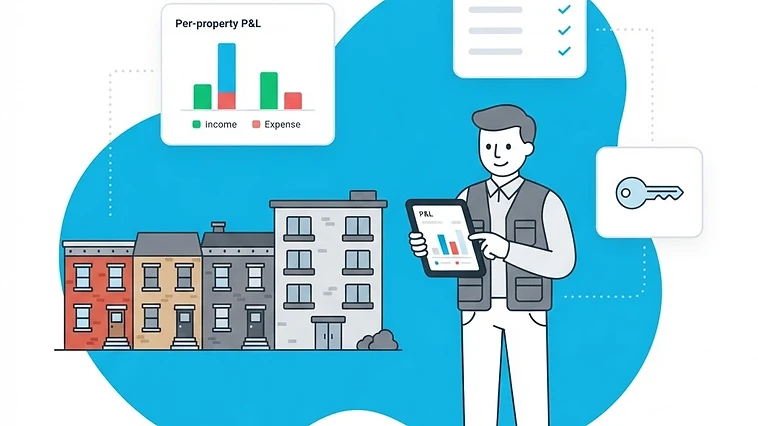
- Profit & loss by property
- Portfolio balance sheet
- Rent roll reconciliation
- Cash flow by property
- Flip project cost report
- Year-end package for your CPA's Schedule E or entity returns
A simple, predictable process
From kickoff to your first clean close, here is exactly what happens.
Portfolio setup
We set up a class or location for each property — or a separate file per LLC — in QuickBooks Online or Xero.
Accounts connected
Operating, reserve and security-deposit accounts, plus property-manager statements, are connected and reconciled.
Monthly property close
Rent matched to your rent roll, mortgages split, and repairs and improvements coded consistently.
Lender- and CPA-ready
Property-level P&Ls, a portfolio balance sheet and a rent roll reconciliation, ready when a lender or your CPA asks.
Real Estate Investors & Landlords bookkeeping — your questions
Can you keep separate books for each rental property?
Yes. We track every property separately — by class or location inside one file, or in separate QuickBooks Online or Xero files per LLC — so you get a profit and loss for each property and for the whole portfolio.
How should security deposits be recorded?
A security deposit is a liability, not income, because you owe it back to the tenant. We record it in a liability account and move it to income only when it's applied to unpaid rent or damages, then reconcile the deposit account monthly.
What's the difference between a repair and a capital improvement?
Generally, a repair keeps a property in working condition and is deducted in the year paid, while an improvement adds value, extends its life or adapts it to a new use and is capitalized and depreciated. We code them consistently and flag larger items for your CPA to decide.
Can you help me get loan-ready financials?
Yes. Lenders typically ask for current profit and loss statements, a balance sheet and a rent roll. Because we close your books every month, those reports are ready when you apply.
Explore other industries
Restaurants
Prime cost, tip pools, POS reconciliation, and food/beverage COGS — booked the way a restaurant actually runs.
Learn more →E-commerce
Multi-channel reconciliation, FIFO/weighted-average inventory, COGS at ship date, and sales-tax nexus done right.
Learn more →Retail
POS reconciliation, COGS, shrinkage, vendor payables, and sales-tax remittance — clean end to end.
Learn more →