Bookkeeping Basics
Bookkeeping vs. Accounting: What’s the Difference and Which Does Your Business Need?
Quick answer
Bookkeeping and accounting are often used interchangeably, but they’re two different jobs. Here’s what each one does, how they overlap, and which your small business actually needs.
If you’ve ever wondered whether you need a bookkeeper or an accountant, you’re not alone. The two roles are often mixed up, and plenty of small business owners use the titles as if they mean the same thing. They don’t. Understanding the difference is the first step to getting clean, reliable financials — and to knowing what kind of small business bookkeeping support you actually need.
What bookkeeping actually is
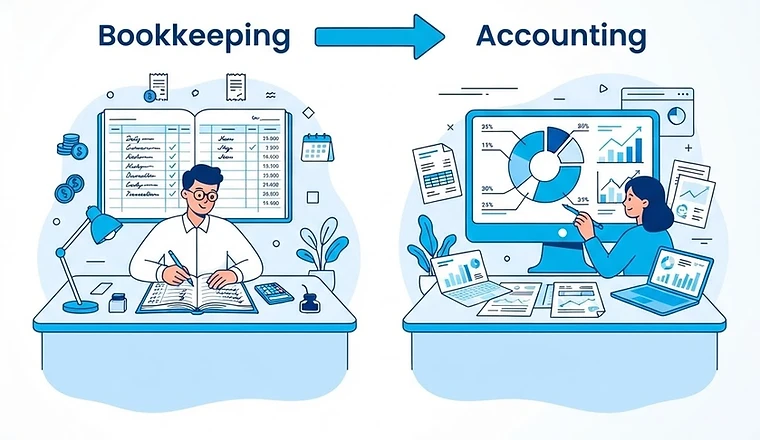
Bookkeeping is the day-to-day work of recording every transaction that moves through your business: sales, expenses, payments, refunds, loan activity, and transfers. A bookkeeper categorizes those transactions, reconciles them against your bank and credit card statements, and makes sure your ledger is complete and balanced. The output is an accurate set of books that reflects exactly what happened in the business for a given period.
Good bookkeeping is the foundation everything else sits on. Without it, reports are guesses, taxes are a gamble, and decisions are made in the dark. Monthly bookkeeping — done consistently — is what keeps that foundation solid instead of letting it rot until tax season.
What accounting actually is
Accounting takes the books a bookkeeper built and interprets them. An accountant prepares financial statements, files taxes, advises on structure and strategy, handles depreciation and amortization, and signs off on more formal reporting. Where bookkeeping asks “what happened?”, accounting asks “what does it mean, and what should we do about it?”
There’s real overlap, especially in small businesses. Many accountants do some bookkeeping, and experienced bookkeepers do some light accounting work. But the core distinction holds: bookkeeping is the record-keeping; accounting is the analysis and compliance work built on top of it.
Key differences at a glance
- Scope: bookkeepers record and reconcile; accountants analyze, report, and advise.
- Timing: bookkeeping is continuous and monthly; accounting work peaks around tax time and reporting deadlines.
- Credentials: accountants often hold CPA or equivalent credentials; bookkeepers may be certified but it’s not required to do great work.
- Cost: bookkeeping is generally less expensive than full accounting services, which is why most small businesses get bookkeeping monthly and accounting as needed.
Which does your business need?
Almost every business needs both — but not necessarily from the same person or at the same time. The healthiest setup for a growing small business is consistent monthly bookkeeping year-round, plus an accountant (or enrolled agent) who steps in for tax filings and higher-level questions. Trying to skip the bookkeeping and have an accountant reconstruct a year of messy transactions at tax time is both expensive and inaccurate.
If you’re a freelancer or solo founder, a dedicated bookkeeping service that works in QuickBooks or Xero is usually the right first step; you bring in accounting support when you face a real tax or structuring question. If you’re running a multi-employee business with payroll, inventory, or loans, you need both running in parallel.
Why most owners get this backwards
The common mistake is hiring an accountant for cleanup work a bookkeeper should have done monthly. You end up paying premium rates for data entry, and the result is still only as good as the source records. The fix is simple: keep the books current every month, and reserve your accountant for interpretation, filing, and strategy.
That’s exactly the model we use at Mispar. We handle the monthly bookkeeping, reconciliation, and reporting so your records are always clean and tax-ready — and we coordinate with your CPA at tax time so nobody’s reconstructing a year of transactions in March.
Not sure where your books stand? Book a free call and we’ll tell you honestly whether you need catch-up bookkeeping, ongoing monthly support, or just a quick sanity check.
Keep reading

Bookkeeping Basics
A Small Business Owner’s Guide to Monthly Bookkeeping
What monthly bookkeeping really involves, why it matters, and how to make it painless — even if you’d rather do literally anything else with your time.

Freelancers
Bookkeeping for Freelancers — The Complete Guide
Freelancer bookkeeping is different from standard small-business bookkeeping — irregular income, quarterly estimated taxes, and commingled accounts. Here is exactly what to track, how to separate your money, and when to stop doing it yourself.
Written by
Moshe
Senior Account Manager, Mispar
Moshe is a Senior Account Manager at Mispar who works directly with small business owners and freelancers to keep their books clean, reconciled, and tax-ready every month.
More about Mispar