Tax & Compliance
Small Business Tax Deadlines to Know (Monthly and Quarterly Checklist)
Quick answer
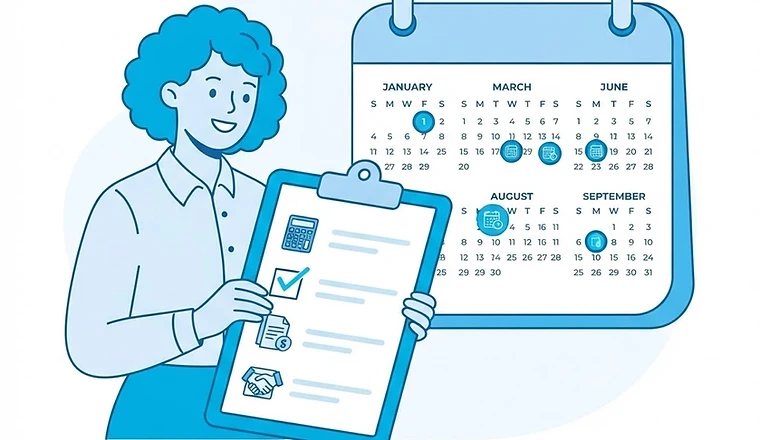
Miss a tax deadline and the penalties add up fast. This checklist covers the monthly and quarterly deadlines every small business owner should have on the calendar.
Tax deadlines are one of the few things in business that have no wiggle room. Miss one and the penalty usually scales with how late you are, which means a disorganized calendar quietly bleeds cash. This checklist covers the monthly and quarterly small business tax deadlines worth memorizing.
Quarterly deadlines (the big four)
If you’re a pass-through entity, a freelancer, or anyone paying estimated taxes, mark these four dates in stone: April 15, June 15, September 15, and January 15. These are when quarterly estimated tax payments are due for the prior quarter’s income. Paying on schedule avoids underpayment penalties; paying late compounds them.
Monthly recurring deadlines
- Payroll tax deposits — generally semi-weekly or monthly depending on your deposit schedule; confirm yours with the IRS.
- Sales tax filings — due dates vary by state and filing frequency (monthly, quarterly, or annually); track each state you collect in separately.
- State monthly minimums and franchise tax installments where applicable.
Annual deadlines you cannot forget
- January 31 — Furnish 1099-NEC and W-2 forms to recipients; file with the IRS.
- March 15 — S corporation and partnership tax returns due (extended with Form 7004).
- April 15 — C corporation and sole proprietor/Schedule C returns due; Q1 estimated payment due.
- Monthly throughout the year — payroll deposits and sales tax filings as scheduled above.
Why 1099 filing trips up so many small businesses
If you paid any contractor $2,000 or more during the year (the threshold for payments made in 2026 and later; it was $600 through 2025) — including designers, developers, cleaners, or anyone not on your payroll — you generally owe them a 1099-NEC by January 31. Miss it and the penalty per form climbs the longer you wait. Clean books make 1099 prep trivial, because you can pull contractor totals in seconds; messy books make it a January fire drill.
What records to keep for an IRS audit
Keep receipts, invoices, bank statements, payroll records, and 1099s for at least three years — longer for property, payroll, and certain filings. Digital is fine; good bookkeeping software keeps these attached to the transaction. If you’re ever audited, the question is rarely “did you spend this?” — it’s “can you prove it was a legitimate business expense?” Clean, attached records answer that instantly.
Turn deadlines into a non-event
Build a simple deadline calendar
A deadline you only remember in the week it is due is a deadline you will eventually miss. Put each recurring date on a shared calendar with a reminder two to three weeks ahead, so there is time to pull reports and gather documents. Add the owner, the bookkeeper and the CPA as attendees so everyone knows who is preparing what.
Dates can shift when they fall on a weekend or holiday, and some states and cities have their own filing schedules for sales tax, payroll and franchise taxes. Treat any list, including this one, as a starting point and confirm current dates on irs.gov and with your state's revenue department or your CPA.
Deadlines are only stressful when your books aren’t ready. Monthly bookkeeping — with reconciliation, clean categorization, and contractor totals tracked all year — turns every deadline into a quick filing. At Mispar, we close your books monthly and prep your 1099s so January 31st isn’t a crisis. Book a call to set up the monthly cadence that makes tax deadlines boring.
Frequently asked questions
What happens if I miss a tax deadline?
The IRS and states generally charge penalties and interest that grow over time. If you cannot file on time, an extension to file is not an extension to pay, so estimate what you owe and pay it by the original date when you can.
Who tracks these deadlines, me or my CPA?
Both. Your CPA knows the rules, but your books supply the numbers. Ask your CPA for your personal list of dates, and make sure your books are closed in time to feed each one.
Do estimated taxes apply to me?
Many sole proprietors, partners and S-corporation owners pay estimated taxes during the year. Your CPA can tell you whether you need to and how much to set aside each quarter.
Keep reading

Small Business Tips
How to Improve Cash Flow in Your Small Business
Profitable businesses fail from cash flow problems all the time. Here’s how to read your numbers and make practical moves that keep real cash in the business.

Bookkeeping Basics
A Small Business Owner’s Guide to Monthly Bookkeeping
What monthly bookkeeping really involves, why it matters, and how to make it painless — even if you’d rather do literally anything else with your time.
Written by
Moshe
Senior Account Manager, Mispar
Moshe is a Senior Account Manager at Mispar who works directly with small business owners and freelancers to keep their books clean, reconciled, and tax-ready every month.
More about Mispar